

If you have sat in a meeting where someone used RPA and AI agents in the same sentence like they mean the same thing, you are not alone. And if you have tried to research the difference yourself, you have probably landed on either a vendor blog selling you their platform or a technical piece written for developers, not business owners. Neither actually helps you decide what your business needs.
Agentic AI vs. RPA is one of the most misunderstood topics in business automation right now, and it matters because choosing the wrong approach can waste real money. This blog breaks down what each one actually is, where each one genuinely works, and how to figure out which one your business needs right now without the jargon.
What Is RPA Automation and How Does It Work?
RPA automation, or robotic process automation, is software that mimics exactly what a human does on a screen. It clicks, copies, pastes, fills out forms, and moves data between systems by following a fixed script that a developer writes in advance. The bot does not think or adapt. It executes the same steps in the same order every single time. When the process is predictable and nothing changes, RPA automation is fast, accurate, and cheap to run. Invoice data entry, payroll processing, compliance logging, and structured report generation are the tasks where it genuinely earns its place because the inputs are always the same and the expected output never varies.
The problem shows up the moment something changes. For example, if a website updates its layout, a vendor sends a PDF in a slightly different format, or a new field appears in a form, the bot breaks, and a developer has to fix it. The RPA software market grew 14.5% to $3.6 billion in 2024, but that growth has slowed as businesses run into the maintenance wall. RPA maintenance runs 20 to 30% of the initial development cost every single year, and that number adds up fast when your processes change more than once or twice a year. In plain terms, RPA automation means a digital worker that does exactly what you tell it to do, nothing more, nothing less, and nothing different.
What Is Agentic AI Automation and How Is It Different?
Agentic AI does not follow a script. You give it a goal, and it figures out how to reach it, reading context, handling exceptions, and deciding what to do next based on what it finds. It does not need a developer to update it every time something changes. Agentic process automation, in simple terms, is a digital worker that understands what you are trying to achieve and works out the steps on its own, rather than waiting for you to define every single click in advance. While RPA automation handles administrative work such as data entry, invoice routing, and copying information between systems, agentic automation handles work that requires judgment. Reading a contract and flagging problem clauses, identifying a high-intent lead and sending a personalised follow-up, analysing customer feedback and surfacing the patterns that actually matter.
The market reflects how fast this is moving. The global AI agents market was valued at $7.6 billion in 2025 and is projected to reach $10.9 billion in 2026, growing at nearly 50% annually. Gartner projects 40% of enterprise applications will embed AI agents by the end of 2026, up from less than 5% just a year ago. Businesses are not waiting to see how this plays out. They are already running agentic AI on real workflows. The question for your business is not whether this shift is happening. It is whether you are ahead of it or still catching up.
Agentic AI vs RPA: The Real Differences Side by Side
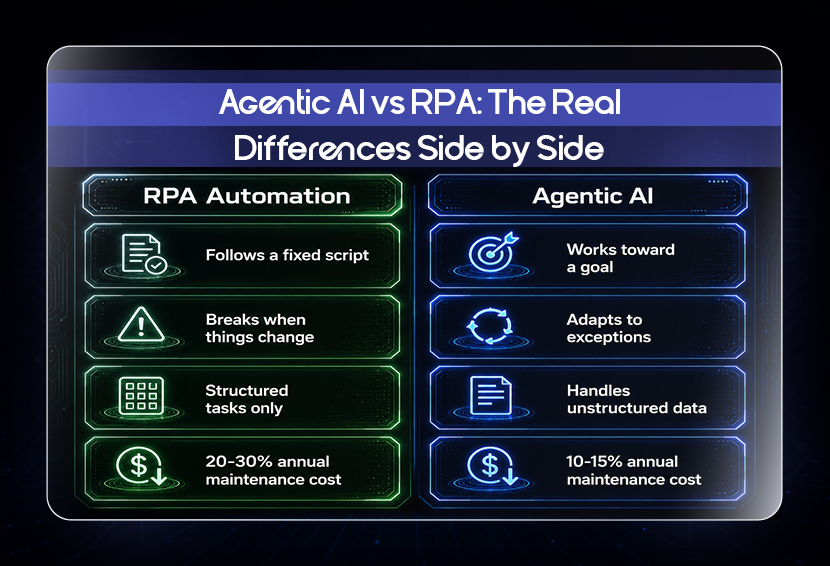
They list features in a table and move on. The actual differences that matter for a business decision are more specific than that. RPA does exactly what it is told and breaks the moment something changes. Agentic AI handles exceptions, adapts to variability, and gets smarter as you scale it. One follows rules. The other thinks.
1. How they handle exceptions: In RPA automation, any deviation from the expected path requires human intervention or a developer fix. A different PDF layout, an unexpected field, or a website that changed its button placement can break the bot. Agentic AI handles exceptions natively. It reads what is in front of it and finds an alternative route without stopping the workflow.
2. How they scale: Scaling RPA means writing more scripts and maintaining more bots. Every new process requires a new development cycle. Scaling agentic AI means refining the instructions you give the agent and adding tools it can use. The maintenance overhead is a fraction of what RPA requires, running 10 to 15% of the initial cost annually versus 20 to 30% for RPA.
3. What they cost over time: Traditional RPA implementations cost approximately $228,000 in year one versus $77,000 for AI automation platforms, a 66% difference. Enterprises that transitioned from RPA to AI agents report a 40% reduction in total cost of ownership within 24 months. The upfront number for RPA can look attractive, but the total cost over two years will not.
4. What kind of work they handle: RPA handles structured, predictable, rule-based work where every input looks the same. AI agents vs RPA for business automation is really a question of structured versus unstructured, predictable versus dynamic. If the process involves reading natural language, making a judgment call, or adapting to variability, RPA cannot do it, but agentic AI can.
At the most fundamental level, RPA is deterministic and fixed. The same input always produces the same output every time. Whereas agentic AI is probabilistic and flexible. It reasons, adapts, and handles change and variation as a key function rather than treating them as errors.
Where RPA Still Makes Sense in 2026
RPA is not dead, and it is not going to disappear. For the right kind of process, it still delivers reliable and cost-effective results in 2026. RPA belongs in processes that are fully predictable, fully stable, and high volume. Payroll processing where every input follows the same format.
Fluctuating processes, such as, Inventory forecasting is a different story, as it involves too many variables for RPA to handle reliably. RPA is useful for predictable processes such as compliance data logging with the same fields, structured report generation pulled from a fixed data source, and fixed-format invoice processing from the same supplier every month. For these processes, RPA works fine, and a more expensive, more complex AI agent deployment would be overkill.
The rule is simple. If the process is rigid and the environment is stable, RPA works. Once things start changing or becoming more complex, agentic AI becomes the better option. Businesses expanding to multiple platforms feel this fast, since each channel introduces its own data formats and exceptions that RPA was never built to handle. If your supplier changes their invoice format once a quarter, you are spending more on bot maintenance than the automation is saving you.
The smarter approach most businesses are taking in 2026 is hybrid. Keep the stable bots running on fixed processes. Redirect all new automation requests to AI agents. Retire the high-maintenance bots first and use the savings to fund the transition. This is how the businesses getting real ROI from automation are actually operating, and it is the approach that reduces operational costs without disrupting what is already working.
Where Agentic AI Adds Value and RPA Cannot
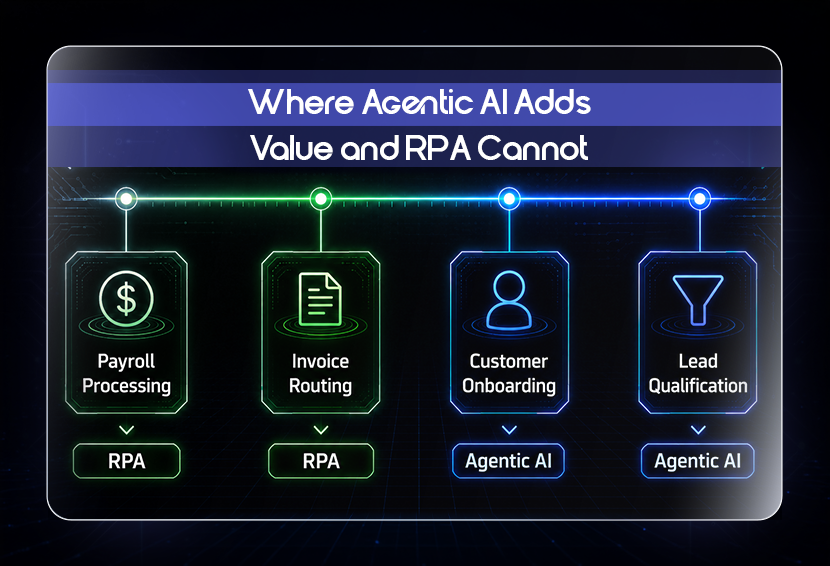
Agentic automation wins where RPA automation cannot compete. AI agents handle entire workflows, not just the structured parts. When something changes, RPA breaks, and an AI agent adapts. Exceptions get handled automatically instead of piling up in a human queue.
1. Customer onboarding: A full onboarding process involves reviewing submitted documents, validating information against multiple sources, updating CRM records, communicating with the customer, escalating missing details, and generating a completion report. RPA can handle the parts of this that are perfectly structured. An AI agent can coordinate the entire workflow, handle exceptions, communicate naturally with the customer, and complete the process end-to-end without human involvement for standard cases.
2. Unstructured document processing: When a vendor changes a PDF layout, an RPA bot breaks. An AI agent reads the invoice, understands what it is looking at, and extracts the right fields anyway. This single capability eliminates one of the most common and most expensive maintenance problems in RPA deployments.
3. Sales follow-up and lead qualification: An AI agent monitors your CRM, identifies a high-intent lead based on behaviour, sends a personalised outreach email, follows up three days later if there is no reply, and books a meeting when the prospect responds. No fixed script, no developer involvement, and the approach adapts to each interaction.
4. Exception handling at scale: Any deviation from the expected path in RPA stops the workflow and creates a queue of exceptions for humans to clear. AI agents reason through exceptions and find alternative routes without stopping. For high-volume processes with frequent edge cases, this difference alone can eliminate entire teams of people whose only job is clearing exception queues.
5. Cross-system coordination with communication: AI agents work across multiple tools, read and write emails, communicate through Slack, and coordinate between systems without API integrations. RPA works within systems but cannot communicate across them naturally.
If you want to understand which of your current processes fall into these categories, What is Business Process Automation: A Complete Beginner's Guide is a useful starting point before making any tool decision.
How to Decide Which One Your Business Actually Needs
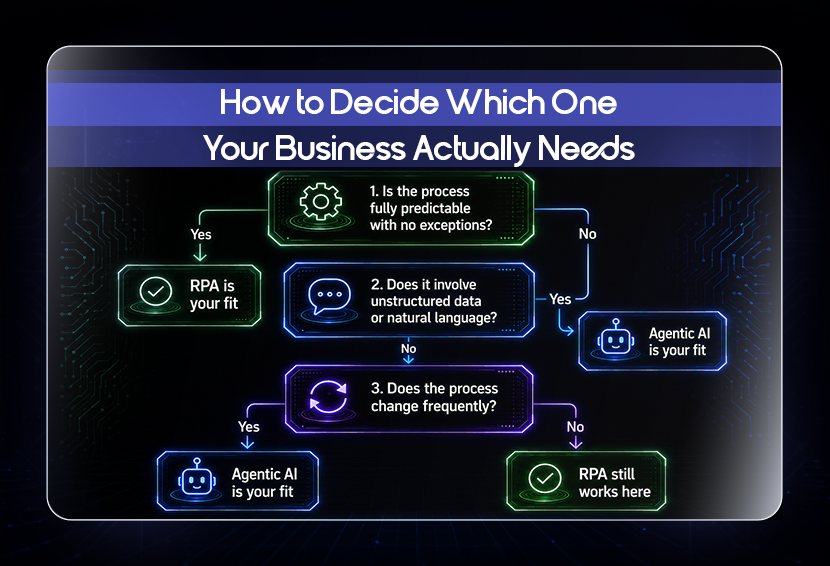
AI agents vs RPA for business automation is not a question of which is better. It is a question of which process you are trying to automate and what that process actually requires. Three questions will tell you almost everything you need to know.
1. Is the process fully predictable with no exceptions?
If yes, and if the environment it runs in is stable, RPA is the right fit. It is cheaper to deploy on a simple, fixed process, and it will run reliably for as long as nothing changes. If the process has exceptions even occasionally, you are already in agentic AI territory.
2. Does the process involve reading, interpreting, or responding to unstructured information?
Emails, documents, customer messages, PDFs from different suppliers, natural language instructions. If any of these are part of the process, RPA automation cannot handle them. Agentic AI is built for exactly this kind of work, and this is the core of what agentic automation actually means in practice.
3. How often does the process change?
If it changes rarely, RPA maintenance is manageable. If it changes frequently, your RPA maintenance costs will quietly eat your ROI within the first year. Every change to the process means a developer, a ticket, a fix, and a testing cycle. AI agents handle changes by adapting, not by breaking.
If you are not sure which of your processes belong in which category, that is exactly what a process assessment is for. SPCTEK works through this with businesses before recommending any automation tool, because the wrong tool for the right process still fails. Start with free process rating to get a clear picture of where your operations stand before making any decisions.
Conclusion
RPA and agentic AI are not rivals fighting for the same job. They are tools built for different types of work, and the businesses getting the most out of automation in 2026 are the ones who understood that early. They mapped their processes first, matched the tool to the task, and stopped trying to make one technology do everything. The ones still struggling are the ones who bought the newest tool and tried to make it fit every problem they had.
The question worth asking is not "should we use RPA or AI, agents?" It is "which of our processes are stable and structured enough for RPA, and which ones need something that can actually think?" Get that answer right first, and the tool decision becomes straightforward. 
FAQs
Q: What is RPA automation?
RPA automation is software that mimics human actions on a screen by following a fixed script. It clicks, copies, pastes, and moves data between systems exactly as programmed. It works well for structured, repetitive, rule-based tasks where nothing changes, but breaks when the process or environment changes unexpectedly.
Q: What is agentic process automation?
Agentic process automation uses AI agents that are given a goal rather than a script. The agent figures out how to reach the goal by reasoning, adapting, and working across multiple tools and systems. It handles exceptions, reads unstructured information, and completes multi-step workflows without needing a developer to define every action in advance.
Q: How is agentic AI different from RPA?
RPA is deterministic. The same input always produces the same output. Agentic AI is probabilistic. It reasons through context, handles variability, and adapts when something changes. RPA automates administrative labour. Agentic AI automates cognitive labour.
Q: How does robotic process automation differ from intelligent automation?
Robotic process automation follows fixed rules and breaks when those rules are violated. Intelligent automation combines AI, machine learning, and reasoning to handle dynamic workflows, exceptions, and unstructured information. RPA is one tool within the broader category of intelligent automation, not a replacement for it.
Q: Can RPA and AI agents work together?
Yes, and this is how most businesses are deploying them in 2026. Stable, predictable processes run on RPA bots. Dynamic, judgment-requiring workflows use AI agents. The two work alongside each other rather than competing, and the businesses getting the best ROI are running both in parallel.
Q: Which is better for small businesses, RPA or AI agents?
It depends on the process, not the business size. If you have a high-volume, fully structured process that never changes, RPA is cost-effective and reliable. If your workflows involve exceptions, unstructured data, or frequent changes, agentic AI delivers better results with lower long-term maintenance costs. Most small businesses benefit from starting with an AI agent on one high-friction workflow before committing to either approach at scale.
Weekly Newsletter
Scale Without Operational Chaos
Get weekly actionable insights and AI updates to improve operations and grow with better systems.
2,400+ operators subscribed
Unsubscribe anytime