

Most people hear the word "audit" and picture an IRS agent going through boxes of receipts. That image is enough to make any business owner nervous. But here's the thing: a business audit is not something that only happens to you. It's something you can do for yourself, on your own terms, and it's one of the most useful habits you can build as a business owner. When you run your own audit, you get a clear, honest look at how your business is actually doing, not how you think it's doing.
This guide is for small business owners, solo operators, and founders who want to take control of their numbers, their processes, and their online presence without spending a week on it. We'll walk you through the whole thing from start to finish, including how AI is making the process faster and smarter than ever before.
This is a rapid diagnostic review, not a substitute for a formal financial, tax, compliance, or internal audit. The goal is to identify issues and priorities, not fully investigate or resolve every finding in one afternoon.
What Is a Business Audit?
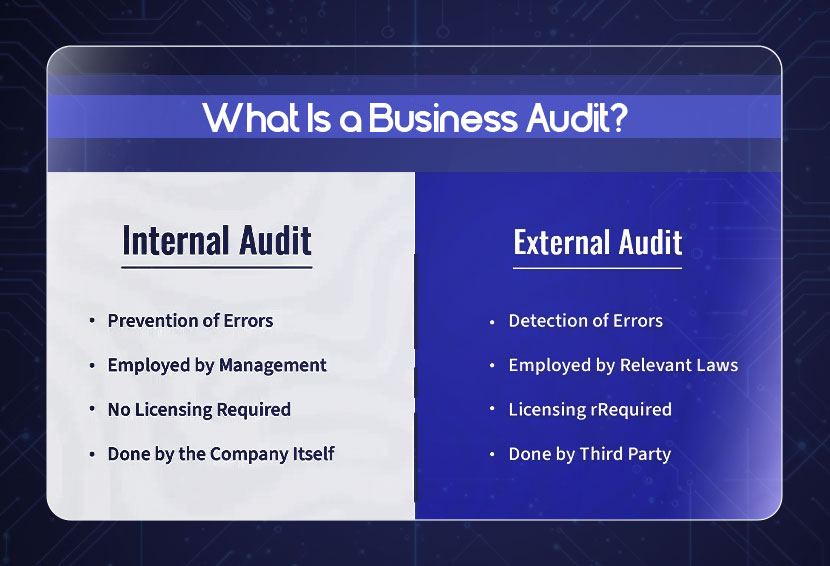
A business audit is a structured review of your finances, operations, and online presence. The goal is to get an honest picture of where things stand so you can make smarter decisions going forward. There are two main types.
- External audit: An independent CPA or audit firm examines financial statements and supporting evidence to provide an independent opinion on whether the statements are materially accurate.
- Internal audit: A small business self-audit is an owner-led review of finances, processes, compliance, and marketing designed to identify issues and improvement opportunities.
- IRS tax examination: An IRS examination reviews tax returns and related records to determine whether tax information and tax liability were reported correctly.
Think of a business audit as a health check for your company. You are not waiting for something to go wrong. You are reviewing things regularly, so small problems do not turn into big ones. This habit is especially valuable for small business owners who wear multiple hats and rarely get the chance to zoom out and look at the full picture. Auditing your business even once a quarter gives you the kind of clarity that makes every other decision easier.
What Is the Main Purpose of a Business Audit?
The main purpose of a business audit is to replace guesswork with real information. It helps you catch gaps before they grow, keeps your decisions grounded in facts, and builds a habit of accountability that makes your business stronger over time. When you know what is actually going on, everything gets easier.
- It replaces guesswork with real data: Feelings and assumptions are not a business strategy. An audit tells you whether your revenue matches your bank account, whether your team's time is going to the right places, and whether your online presence is actually bringing customers in.
- It helps you catch gaps before they grow: A forgotten subscription, a process that quietly doubled in time, an incorrect phone number on your Google listing. None of these are disasters on their own, but left unchecked, they add up and cost you more than you realize.
- It keeps your decisions grounded in facts: When you know what is actually going on inside your business, everything gets clearer. You can have an honest conversation with a potential investor, a bank, or even a new hire because you are not guessing; you actually know.
- It builds a habit of accountability: Businesses that audit regularly do not just catch problems faster. They also build cleaner records, tighter processes, and a stronger foundation for growth over time.
What Are the Most Common Audit Types Used in Businesses?
A financial audit checks your numbers. An operational audit finds workflow gaps. A compliance audit keeps licenses current. A small business digital marketing audit reviews your online performance. A Google Business Profile audit checks your Google listing. Birdeye's 2026 Google Business Profile research found that verified profiles generated up to four times more website visits, along with higher call and direction-request activity. Each of these audit types serves a different purpose. Together, they give you a full picture view of your business from your books to your Google listing.
Here's a quick overview of the most common types a small business owner should know about.
Financial Audit
This is the most well-known type. A financial audit reviews your income, expenses, tax filings, bank records, and overall accounting accuracy. The goal is to confirm that your numbers reflect what actually happened in the business. You can do a basic version yourself using tools like QuickBooks or Xero, or hire a CPA for a deeper review. This type is most important at year-end or before applying for a loan.
Operational Audit
An operational audit looks at how your business runs day to day. Are your workflows efficient? Are tasks taking longer than they should? Is work getting stuck because it depends on one person? This type of audit is the backbone of streamlining operations for small businesses, finding the friction in your processes and fixing it before it becomes a real problem.
Compliance Audit
This one checks whether your business is following the rules. Licenses, permits, employment laws, and data privacy regulations, these things change, and it's easy to fall behind without noticing. Compliance requirements should be reviewed on a schedule appropriate to your industry, location, workforce, and regulatory obligations.
Marketing and Digital Audit
A small business digital marketing audit looks at how you show up online and whether your marketing is actually producing results. It covers your website, social media presence, email campaigns, and how well your content is reaching the people you want to reach.
Google Business Profile Audit
A Google Business Profile audit, previously known as a Google Business Profile audit, is a specific check of your listing on Google Search and Maps. It looks at your name, address, phone number, hours, photos, categories, and reviews. Fully populated and verified profiles appear 80% more often in search results and generate four times more website visits than incomplete listings. That's a significant difference, and fixing your profile can take less than 20 minutes.
What Are the Key Steps Involved in an Audit Process?
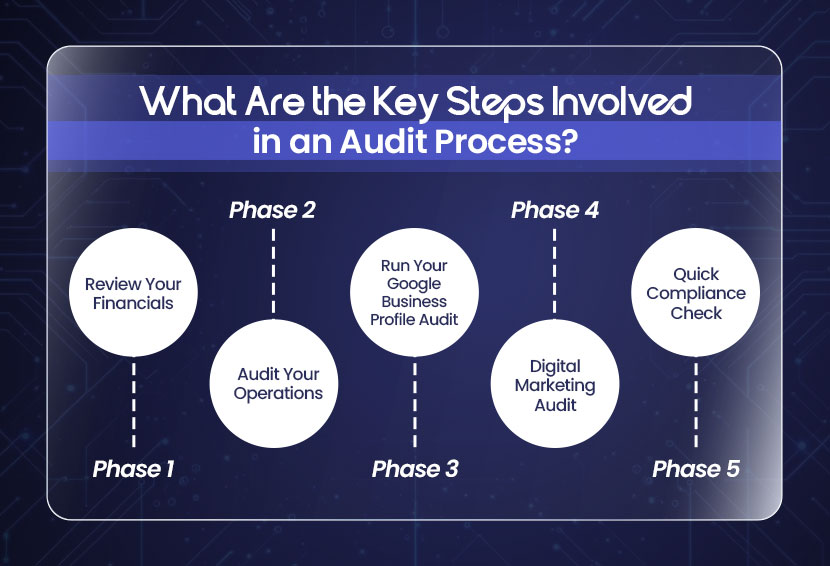
You don't need to book a full day or hire anyone to do this. With a focused afternoon and a clear plan, you can cover all five core areas of your business. Check your finances, map your workflows, audit your Google Business Profile, review your digital marketing, and confirm your licenses and compliance are all current. Each phase takes 15 to 45 minutes, and together they give you a full picture of your business in one afternoon.
Phase 1: Review Your Financials (45 Minutes)
Open your accounting software and work through the following:
- Revenue vs. expenses for the past 90 days: Are you profitable? Are there months that look unusual?
- Outstanding invoices: Who owes you money, and how old are those balances?
- Recurring expenses: Go line by line. Are you paying for tools or subscriptions you no longer use?
- Tax obligations: Are required tax filings, estimated payments, payroll taxes, and relevant records current?
- Bank reconciliation: Have bank and credit-card accounts been properly reconciled, with outstanding or unexplained differences investigated?
You're not looking for perfection. You're looking for anything that doesn't add up or has been ignored too long.
Phase 2: Audit Your Operations (30 Minutes)
This phase is about how work actually gets done inside your business.
- Map your key processes: How does a new customer go from first contact to paying client? Write it out step by step.
- Look for bottlenecks: What slows things down most often? What do customers complain about?
- Review your tools: Are you using everything you're paying for? Is anything duplicated across platforms?
- Check your team: Are the right tasks assigned to the right people? Is anyone overwhelmed or underused?
This is where streamlining operations for small businesses actually happens, not in theory, but by looking at the real workflow and finding what's slowing it down.
Phase 3: Run Your Google Business Profile Audit (20 Minutes)
Search your business name on Google and open your Google Business Profile. Go through each of these:
- Name, Address, Phone (NAP): Is every detail accurate and consistent with your website?
- Business hours: Are they up to date, including holidays and seasonal changes?
- Primary business category: Does it accurately reflect what you actually do?
- Photos: Do you have recent, high-quality images? The profile photo should be a clear, high-resolution image of your logo or storefront. Your cover photo should be attractive and relevant to your services.
- Reviews: When did you last respond to a review? Are there unanswered negative reviews sitting there?
- Business description: Is it clear, specific, and current?
- Posts and updates: Have you posted anything in the last 30 days?
A basic profile review can often be completed quickly, although more complex listing issues may require additional work. Set aside about 20 minutes for an initial review.
Phase 4: Digital Marketing Audit (30 Minutes)
Your small business digital marketing audit doesn't require fancy tools, just an honest look at what's working and what isn't.
- Website: Does it load fast? Does it work well on mobile? Is the contact information correct?
- Social media: Which platforms are you on? Which ones are actually generating leads or engagement?
- Email marketing: Are you collecting emails? When did you last run a campaign?
- SEO basics: Does your website show up when someone searches for what you offer in your city?
- Analytics: Are you tracking website traffic? Do you know where visitors come from?
Phase 5: Quick Compliance Check (15 Minutes)
Short but important:
- Are all your business licenses and permits current?
- Are your contracts and client agreements up to date?
- If you collect customer data, are you handling it in line with privacy regulations?
- Do you have current business insurance?
- Are your employee or contractor agreements in order?
Quick Business Audit Checklist
A business audit checklist doesn't need to be complicated. Here's everything broken down into one clean, scannable list you can save and come back to every quarter. If you'd rather have someone walk you through this process, professional business audit services can cover all of this and more.
Here's everything from the five phases in one place, organized by category, so you can move through it quickly.
Financials
- Revenue and expenses reviewed for the past 90 days
- Outstanding invoices identified and followed up on
- Recurring expenses reviewed line by line
- Bank account reconciled with accounting records
- Tax obligations confirmed and current
Operations
- Key workflows mapped from start to finish
- Bottlenecks and delays identified
- Software and tools reviewed for usage and overlap
- Team roles and workload assessed
Google Business Profile
- Name, address, and phone confirmed accurate
- Business hours updated (including holidays)
- Photos recent and high quality
- Recent reviews reviewed and appropriate responses completed
- Recent posts or updates reviewed if relevant to the business
Digital Marketing
- Website loads fast and works on mobile
- Social media channels active and consistent
- Email list maintained, and recent campaign sent
- Basic local SEO check completed
- Website analytics are being tracked
Compliance
- All licenses and permits are current
- Contracts and agreements reviewed
- Insurance current and adequate
- Data privacy obligations reviewed
How Is AI Transforming the Auditing Process?
For a long time, auditing meant hours of manual work pulling records, cross-referencing spreadsheets, and chasing down documents. AI is changing that in a real and practical way. For small business owners, especially, this shift means auditing your business takes less time and catches more things than it used to.
Here's a closer look at the four biggest ways AI is making business audits faster, sharper, and more useful.
1. AI Can Spot Errors Humans Miss
Traditional audit procedures often use sampling for certain tests. Data analytics and AI can make full-population analysis practical for some transaction sets. AI doesn't work that way. AI can test 100% of entries across your general ledger, flagging anything that doesn't meet expected patterns. AI-assisted audit tools can analyze an entire transaction population and flag entries that fall outside defined patterns or controls for further review. A tool like MindBridge scans your full financial dataset instead of just a sample.
2. Audits That Used to Take Days Now Take Hours
The data collection and categorization steps of a traditional audit are exactly the kind of repetitive work AI handles well. AI platforms can handle data entry and reconciliation with speed and accuracy that would be impossible manually, freeing up time for the higher-level work that actually requires human judgment. What used to take a full day can now be completed in an afternoon. Tools like Botkeeper automate the repetitive bookkeeping tasks that used to eat up hours.
3. Real-Time Monitoring Instead of One-Time Reviews
Some AI-enabled financial and audit tools support continuous monitoring, allowing unusual transactions or exceptions to be flagged between periodic reviews. This means you're not discovering a problem in December that started in March. You see it when it starts, while it's still easy to fix. QuickBooks' Accounting AI can suggest categories, match transactions, and identify potential anomalies for review.
4. Smarter Decision-Making from Audit Findings
AI doesn't just surface problems; it uses predictive analytics to forecast where risks are most likely to show up, helping you focus your attention on the areas that matter most. Instead of finding out what went wrong, you get insight into what might go wrong, which is far more useful for running a business. For example, tools like Xero apply predictive analytics through its cash flow forecasting, helping you spot financial risks ahead of time.
What Are the Best AI Audit Tools and Software for Small Businesses?
You don't need enterprise-level software to start using AI in your audit process. There are solid AI audit tools available at every budget level, and many of them work with systems you're probably already using. Here's a quick look at the most practical options. Each of these AI audit software options serves a different need, from basic bookkeeping to advanced anomaly detection. Pick based on where your biggest time drain currently is.
- QuickBooks (AI Features): Automatically categorizes transactions, flags unusual activity, and generates financial reports. Best for small businesses already in the QuickBooks ecosystem. Learn more
- Xero: Automates bank reconciliation, tracks cash flow, and produces clean audit-ready reports. Great for small teams who want straightforward financials without an accounting background. Learn more
- Botkeeper: Combines AI with human oversight to handle bookkeeping and flag inconsistencies. Built specifically for small business audit prep. Learn more.
- MindBridge: Analyzes your full financial dataset and assigns risk scores to transactions using anomaly detection. Ideal for businesses that want deeper financial insight. Learn more
- Gemini in Google Workspace: Not a dedicated audit tool, but useful for reviewing, summarizing, and organizing audit documents quickly inside Google Workspace. Learn more
Read More: What is Business Process Automation? A Complete Beginner's Guide
How Often Should You Audit Your Business?
This is one of the most common questions small business owners ask, and the honest answer is: more often than most people do. When it comes to external audits from the IRS, the odds are actually quite low for most small businesses. IRS examination rates vary considerably by taxpayer type, income level, business structure, and enforcement priorities. The IRS publishes current examination-coverage data annually in its Data Book. IRS enforcement priorities may place greater emphasis on higher-income and complex taxpayers, but small-business returns can still be selected for examination. So while it makes sense to keep clean records, an IRS audit is not something most small business owners should be losing sleep over.
Internal audits are a different story. Those are in your control, and doing them regularly is one of the best habits you can build. A full internal business audit once a quarter is a solid baseline. Your Google Business Profile is worth checking monthly, especially since Google can update listing information based on external signals, which means something might change without you realizing it. Your financials are worth a lighter monthly review, with a more thorough look each quarter.
The goal isn't to make auditing a big event. It's to make it a normal part of how you run your business.
Conclusion
A business audit is not a punishment. It's a tool, and when you use it regularly, it gives you something most business owners don't have: a clear, accurate picture of what's actually going on inside your company.
You don't need to hire a team or block out a whole week. Start with the checklist in this guide. Pick one afternoon, work through the five phases, and see what you find. A first review will often surface outdated information, unnecessary costs, process bottlenecks, or records that need attention. If you'd like support running a thorough business audit or want to explore business audit services that handle the heavy lifting for you, SPCTek.ai is here to help.
FAQs
Can I do a business audit myself, or do I need a professional?
You can absolutely do a basic internal audit yourself using this guide. A professional becomes useful when your finances are complex or when you need an external review for investors or lenders. Start yourself, then bring in help if needed.
How long does a business audit take?
A focused internal audit for a small business can be done in one afternoon. External audits handled by an accountant or the IRS take longer, depending on complexity. The five-phase approach in this guide is built to fit into a single sitting.
What happens if I find problems during my audit?
Finding issues is the whole point. Prioritize them by impact, fix the quick wins first, and make a plan for the bigger ones. If no issues appear, confirm that the review covered the important areas and document the result for comparison during the next review.
Do I need special software to run a business audit?
No, you can start with tools you already use, like QuickBooks, Xero, or even a spreadsheet. AI audit tools make the process faster and sharper, but they are not a requirement to get started.
Is a business audit the same as a tax audit?
An IRS examination is a tax-compliance review conducted by the government. The self-audit in this guide is a voluntary internal business review used to identify problems and opportunities.
How do I know which area of my business to audit first?
For a general owner review, finances are a practical starting point. If you already know of a significant compliance, operational, or customer issue, prioritize the highest-risk area first
Weekly Newsletter
Scale Without Operational Chaos
Get weekly actionable insights and AI updates to improve operations and grow with better systems.
2,400+ operators subscribed
Unsubscribe anytime