

Three months after signing the contract, the workflows are running. Orders are routing, emails are going out, and data is moving between systems. Then something breaks. You call the agency. They fix it and send an invoice for "ongoing support." You ask to look at how the system is built. Turns out it all lives in their account, their tools, their login. You own the business, but they own the automation.
This situation is more common than most agencies will admit. The problem is not that businesses are choosing bad technology. It's that they're walking into these relationships without knowing what to ask. And by the time the gaps show up, the contract is already signed.
Why Is It So Hard to Evaluate an AI Automation Agency Right Now?
The market flooded fast. Between 2023 and 2025, many agencies updated their websites, added AI to their service list, and started pitching automation to mid-sized businesses. The decks look nearly identical. The logos are different, but the promises are the same.
What actually separates agencies is not what they show you in a sales call. It's what happens after deployment. RAND notes that some estimates suggest more than 80% of AI projects fail, highlighting how difficult it can be to turn AI initiatives into measurable business results. RAND's research found that misunderstanding or miscommunicating the business problem is one of the most common reasons AI projects fail. That makes defining the business objective and success metrics before implementation critical.
The demo works, but the production systems are different: the way they deal with real data, API failures, edge cases, and processes is not the same as promised in the scoping call. Mid-sized businesses are the most exposed here because they're too large to DIY automation and too small to have an internal team that can properly vet what an agency is proposing.
If you're new to what business process automation actually involves before layering AI on top, this beginner's guide is a good place to start.
Before You Call Anyone, What Should You Audit Internally?
You cannot brief an agency well on something you haven't mapped yourself. A vague brief produces a vague system, and when something breaks six months later, there's no clear standard to measure it against.
1. Map What You Actually Want Automated: Not the biggest problem in your business, but the most repetitive one. The tasks your team does the same way every day, with no variation. Those are what automation handles best. Anything that requires judgment belongs lower on the list.
2. Know Where Your Data Lives: Which tools hold your customer records, order data, and operational information? An agency will ask this on day one. If you don't have a clear answer, the scoping conversation will eat up a lot of time and produce a lot of assumptions.
3. Define What Success Looks Like Before the First Call: Hours saved per week, error rate before and after, cost per transaction processed. If you can't name a metric now, you won't be able to hold anyone accountable for delivering one later.
Also Read: How to Do a Complete Business Audit in One Afternoon
What Questions Should You Ask Before Hiring an AI Automation Agency?
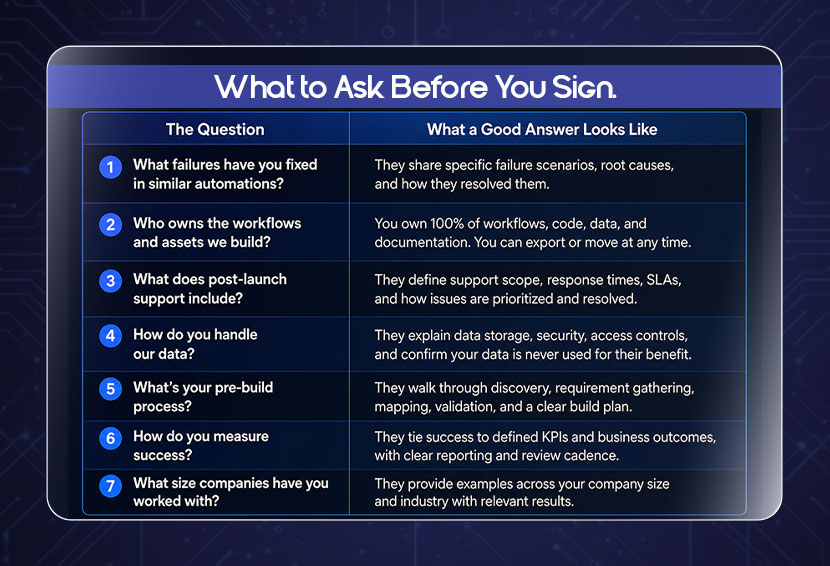
Before hiring an AI automation agency, ask about real failures they fixed, confirm you own everything in writing, and nail down what post-launch support actually costs. Find out where your data goes, make sure they map your processes before building anything, and check that they have worked with businesses of your size.
1. Can You Show Me Something You Built that Broke, and How You Fixed It?
A polished case study tells you what an agency wants you to know. How they handle failure tells you what they actually know. Agencies with real production experience can walk you through edge cases, what failed, and what the fix looked like. Agencies that have only run demos don't have that story.
2. Who Owns the Workflows After the Project Ends?
This needs to be answered in writing before anything gets built. Full source code, documentation, and login access should transfer to you on day one of deployment. If the answer is vague, or if the workflows live inside the agency's account, it can mean that you don't own your automation.
3. What Does Support Look Like After Launch?
Automation performance can decline over time without proper monitoring and maintenance. APIs change, business processes evolve, and edge cases emerge, so a workflow that works well at launch may need adjustments later. APIs get updated frequently, and business processes change, so a workflow running perfectly in month one can fail quietly by month four. Ask who you call when that happens, how fast they respond, and whether support is included in the project fee or billed separately.
4. How Do You Handle Our Data, and Where Does It Go?
Ask which third-party tools will process your data, where it gets stored, and what happens to it if the relationship ends. This matters for any business handling customer records, and especially for those in healthcare, retail, or finance, where data handling carries compliance requirements.
5. What Is Your Process Before You Build Anything?
The answer should include mapping your current workflows, identifying gaps, and agreeing on scope before a single automation gets touched. If an agency skips this step and goes straight to building, they're working on assumptions about how your business operates. Those assumptions will cost you later.
6. How Will We Measure Success, and Who Tracks It?
Projects with clearly defined success metrics upfront achieve a 54% success rate, compared to just 12% for those without. Hours saved, error rate reduction, cost per transaction; these numbers need to be agreed on before work begins, not calculated afterward to justify the invoice.
7. Have You Built This for a Business of Our Size?
An agency built around enterprise rollouts operates differently from businesses with 50 to 200 employees. The tools, the timelines, and the support models are different. Ask for a reference from a business close to your size, not just your industry.
What Are the Red Flags That an AI Automation Agency Is Not the Right Fit?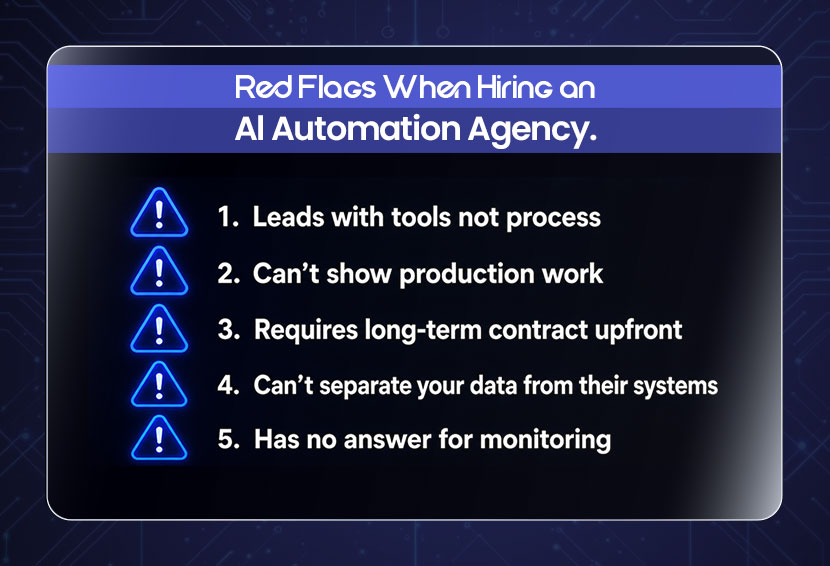
A trustworthy AI automation agency diagnoses your problems before recommending tools. They prove value before locking you into contracts. They build systems you own and can export. They monitor everything from day one. If they cannot do all four, keep looking.
1. They Lead With Tools, Not Process: If the first thing out of their mouth is the tech stack Zapier, Make, n8n, whatever, they're selling software. A real artificial intelligence automation agency asks what's breaking in your operations before recommending anything.
2. They Can't Show Production Work: Ask to speak with a client who went live six months ago, not one who launched last week. Recent launches haven't had time to break yet. Six months will tell you whether the system held up.
3. They Require a Long-term Contract Before Delivering Anything: Agencies confident in their work offer a defined project first and expand based on results. Be cautious about long-term commitments that begin before scope, deliverables, milestones, and exit terms are clearly defined.
4. They Can't Separate Your Data from Their Systems: Ask directly if this relationship ended tomorrow, could we export everything and hand it to someone else? If the answer involves any hesitation, you don't own what's being built.
5. They Have No Answer for Monitoring: If an agency can't tell you how they'll know when something breaks post-launch, silent failures are already part of the plan. Good AI automation agency services include logging, alerts, and regular performance checks as standard, not an upsell.
How Do You Know If the AI Automation Is Actually Working?
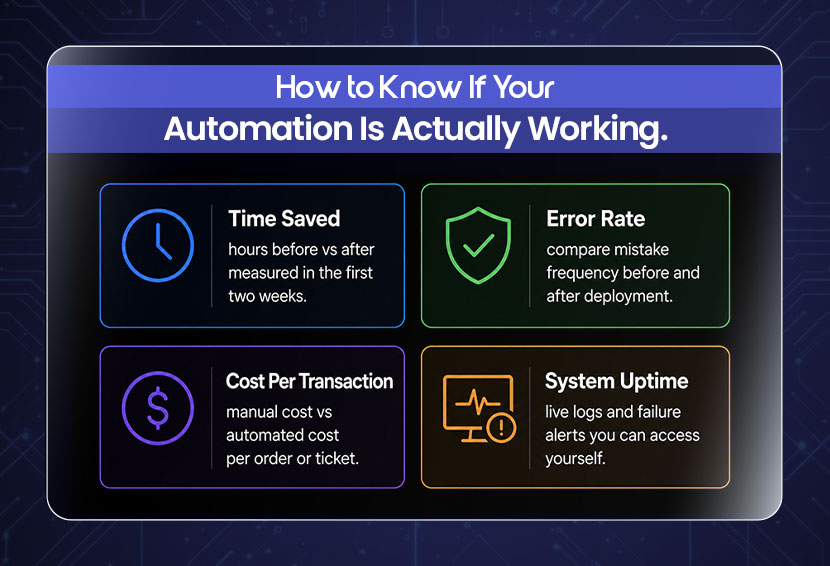
Most businesses sign off on an automation project and assume it's working because nothing visibly broke. That's not the same as working. Track hours saved, error rate changes, cost per transaction, and system uptime with logs you can access yourself. Choose metrics that reflect the workflow's business goal. Common measures include time saved, error rate, cost per transaction, uptime, conversion rate, and exception rate.
- Time saved per process: Hours before vs. after. Measure this in the first two weeks of deployment, not six months later when the baseline is gone.
- Error rate change: Every manual process has an error rate. Data entry mistakes, missed follow-ups, wrong order details. If your agency can't show you how that number changed after automation, they're tracking whether the workflow ran, not whether it delivered anything.
- Cost per transaction: What it costs to process one order, one support ticket, or one invoice manually vs. automatically. This is the number that makes ROI conversations concrete instead of theoretical.
- System uptime and failure logs: A good agency shows you this without being asked. Without monitoring, failure alerts, or accessible logs, problems can go unnoticed.
Also Read: How Can Automation Reduce Business Operational Costs
Conclusion
Most businesses hiring an AI automation agency right now are doing it for the first time. They know they need automation. They've seen what it can do, but they don't always know what they're agreeing to until a few months in, when the cracks start showing.
The businesses getting this right are not necessarily picking the most advanced agency or the one with the best deck. They're asking harder questions earlier about what breaks, who owns it, how success gets measured, and what happens after launch. Those questions cost nothing to ask before you sign. They cost a lot more to figure out afterward.
FAQs
Q: What is an AI automation audit?
A: A review of your workflows, tools, and data flows to find what is failing quietly and what should be automated next. Run one before hiring an agency and review the process again after the automation has had enough time to stabilize.
Q: How do I measure AI automation success?
A: Start with hours saved and error-rate changes, then add metrics that reflect the workflow's specific business objective
Q: Does AI automation require maintenance?
A: Yes, APIs break, processes change, and AI models drift when real-world data shifts. Any agency that does not bring up maintenance before you sign is saving it for a future invoice.
Q: What should I know about AI safety and compliance?
A: Ask which third-party tools will touch your data, where it is stored, and whether the agency signs a data processing agreement. Resolve this in the contract, not after deployment.
Q: How do I vet AI automation agencies in 2026?
A: Ask for production references and a walkthrough of a project that failed. Confirm you own all deliverables upfront and do not sign anything long-term before seeing a working pilot.
Weekly Newsletter
Scale Without Operational Chaos
Get weekly actionable insights and AI updates to improve operations and grow with better systems.
2,400+ operators subscribed
Unsubscribe anytime